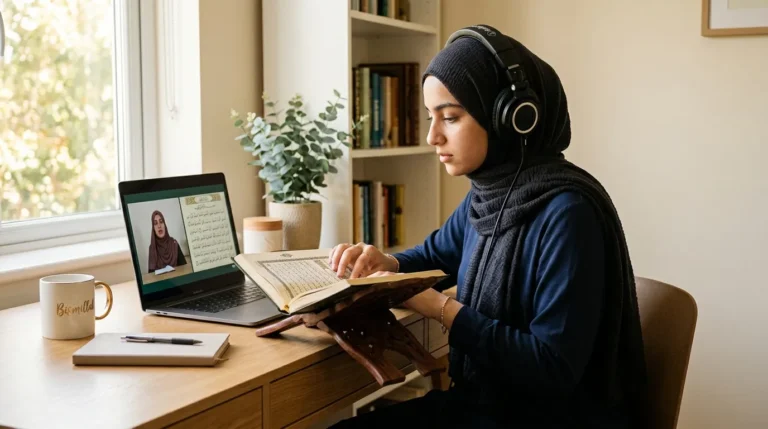
How to Practice Tajweed at Home Without Reinforcing Bad Habits
Practicing Tajweed at home safely means repeating only material a teacher has already corrected, checking yourself against a reliable reference recording rather than guessing, and avoiding tackling brand-new rules or unfamiliar passages entirely on your own between lessons.
Independent practice between classes is genuinely valuable, but it carries a real risk: repeating a mistake many times at home can make it harder to correct later than if the student had practiced less. This post covers how to get the benefit of home practice without accidentally working against your own progress.
Why Home Practice Can Backfire
Repetition builds muscle memory regardless of whether what’s being repeated is correct — practicing an uncorrected mistake fifty times at home doesn’t just fail to help, it actively strengthens the wrong habit, making the eventual correction harder than if less practice had happened.
What's Safe to Practice Independently
Material a teacher has already explicitly corrected, reviewed and confirmed as accurate is generally safe to repeat at home, since the student is reinforcing something already verified rather than guessing at something new.
What's Risky to Practice Without Guidance
Brand-new Tajweed rules not yet covered in class, or unfamiliar passages containing letter combinations a student hasn’t specifically worked through with a teacher, carry a higher risk of practicing an undetected error repeatedly before it’s ever caught.
Using Reference Recordings the Right Way
Listening to a trusted, well-known reciter’s recording of the same passage, then comparing your own attempt against it, can help catch some errors independently — though this works better as a supplement to teacher correction than a full substitute for it, since subtle errors are easy to miss by ear alone.
How Often and How Long to Practice
Short, frequent practice sessions, focused specifically on recently corrected material, tend to be more effective than occasional long sessions, since consistency matters more than total volume for building accurate habits.
Warning Signs You Might Be Reinforcing a Mistake
- A teacher repeatedly corrects the exact same error week after week despite regular home practice
- You feel confident about a rule you’ve never actually had confirmed by a teacher
- Practice sessions consistently cover material well beyond what’s recently been taught
How to Structure Practice Around Your Teacher's Guidance
Asking a teacher directly what’s safe to practice independently that week, rather than assuming, keeps home practice aligned with what’s actually been verified, turning it into a genuine accelerator for progress rather than an accidental source of new mistakes to unlearn later.
Using a Simple Practice Log to Track What's Been Verified
Keeping a short written log of which specific words or rules a teacher has confirmed as correct helps avoid accidentally practicing unverified material from memory, especially as the amount of covered material grows over weeks and months.
Practicing With a Study Partner or Family Member
Practicing alongside another person who can at least follow along with a reference recording, even without formal Tajweed training themselves, can help catch some obvious errors and adds a layer of accountability beyond practicing entirely alone.
When to Pause Independent Practice Entirely
If a specific area consistently produces confusion or repeated mistakes despite careful, guided practice, it’s sometimes more effective to pause independent work on that specific point entirely and wait for focused teacher attention, rather than continuing to practice around an unresolved confusion.
How to Handle Practicing Without Access to a Teacher for a While
During a temporary gap without regular teacher access, such as a short break between terms, focusing practice exclusively on well-established, long-confirmed material is safer than attempting to advance into new territory without available correction.
Balancing Confidence With Appropriate Caution
The goal of cautious home practice isn’t to create hesitation or self-doubt about every attempt, but simply to direct independent effort toward material that’s genuinely safe to reinforce, while saving newer or uncertain material specifically for guided class time.
Key Takeaways
- Repeating an uncorrected mistake at home strengthens the wrong habit
- Only recently teacher-corrected material is generally safe to practice independently
- New, uncovered rules carry a higher risk when practiced without guidance
- Reference recordings supplement, but don't replace, teacher correction
- Short, frequent sessions beat occasional long ones for building accuracy
- Asking a teacher what's safe to practice keeps home practice genuinely useful
- A short log of teacher-verified material prevents practicing unverified content
- A study partner adds useful accountability even without formal Tajweed training
- During gaps without teacher access, stick to well-established, confirmed material
- The goal is directing practice wisely, not creating hesitation about practicing at all
Frequently Asked Questions
Can practicing Tajweed at home make things worse?
Yes, if you repeat an uncorrected mistake many times, repetition strengthens the wrong habit rather than building a correct one.
What's safe to practice independently between classes?
Material a teacher has already explicitly corrected and confirmed as accurate is generally safe to repeat at home.
Should I practice brand-new Tajweed rules on my own?
It's risky — unfamiliar rules or passages not yet covered with a teacher carry a higher chance of an undetected error being practiced repeatedly.
Are reference recordings useful for independent practice?
Yes, comparing your recitation to a trusted reciter's recording can help, though it works best as a supplement to teacher correction, not a replacement.
How often should I practice Tajweed at home?
Short, frequent sessions focused on recently corrected material tend to be more effective than occasional long sessions.
How do I know if I'm reinforcing a mistake instead of fixing it?
If a teacher keeps correcting the exact same error despite regular practice, it's a sign that practice may be reinforcing rather than fixing the habit.
Should I keep a log of what's been verified by my teacher?
Yes, a short log of confirmed material helps avoid accidentally practicing unverified content as the amount covered grows over time.
Is it helpful to practice Tajweed with a study partner?
Yes, practicing alongside someone who can follow a reference recording adds accountability and can help catch some obvious errors.
What should I practice if I don't have teacher access for a while?
Focusing exclusively on well-established, long-confirmed material is safer than attempting new territory without available correction.
Does this mean I should be hesitant about all home practice?
No, the goal is simply directing independent effort toward genuinely safe material, not creating general hesitation about practicing at all.
Practice With Confidence, Not Guesswork
Book a free trial class and get clear guidance on what to practice safely at home.
Book a Free Trial Class Chat on WhatsApp