How to Soften a Heavy Regional Accent While Reciting Quran
A heavy regional accent in Quran recitation usually isn’t a Tajweed error itself — it’s your native language’s sound patterns bleeding into Arabic pronunciation. The fix isn’t to erase your natural voice, but to retrain the specific sounds that differ between your native language and correct Arabic articulation.
A heavy regional accent in recitation usually isn’t a Tajweed error itself — it’s your native language’s sound patterns showing through. Here’s how to work on it without losing your natural voice.
Why Your Native Accent Bleeds Into Your Recitation
Every language shapes the mouth, tongue, and throat toward a specific set of habitual sounds from early childhood, and those habits don’t disappear simply because you’re now reading a different language. When reading Arabic, the mouth instinctively defaults to whatever movements feel most natural, which often means substituting an unfamiliar Arabic sound with the closest equivalent from your native language.
This is a completely normal linguistic phenomenon, not a personal shortcoming, and it happens to nearly every non-native reciter to some degree. Recognizing this removes unnecessary frustration and reframes the issue as a specific, fixable set of sound substitutions rather than a vague, general problem.
The Difference Between an Accent and an Actual Tajweed Error
It’s important to separate two different things that often get lumped together: a general accent, which affects tone and rhythm without necessarily changing which letter is being pronounced, and an actual Tajweed error, where one Arabic letter is replaced with a different one entirely, changing the sound in a way that affects correctness.
A slight overall tone or rhythm influenced by your native language is far less significant than substituting, for example, ق with ك, which is a genuine pronunciation error rather than simply an accent. Identifying which category a specific habit falls into helps prioritize what actually needs correction.
Common Accent-Related Habits Across Different Language Backgrounds
Speakers of different native languages tend to bring specific, predictable habits into their Arabic recitation. For example, speakers of languages without heavy letters often flatten letters like ص and ط into their lighter counterparts, while speakers of languages with strong stress patterns sometimes emphasize the wrong syllable within Arabic words, since Arabic stress patterns work differently.
Being aware of the specific tendencies common to your own native language background helps you know exactly what to listen for in your own recitation, rather than trying to fix everything generally without a clear target.
Retraining Your Mouth Through Slow, Isolated Practice
The most effective way to shift an ingrained accent habit is slow, isolated practice on the specific sound involved, separated entirely from the speed and rhythm of normal reading. Saying a single difficult letter or word slowly, dozens of times, while consciously adjusting mouth position, retrains the muscle memory far more effectively than reading through full passages at normal speed.
This kind of practice can feel tedious compared to reading full verses, but it directly targets the specific muscle movements involved, which is exactly what needs to change for a lasting correction rather than a temporary, conscious adjustment that reverts under normal reading speed.
Listening-Based Correction: Shadowing Qualified Reciters
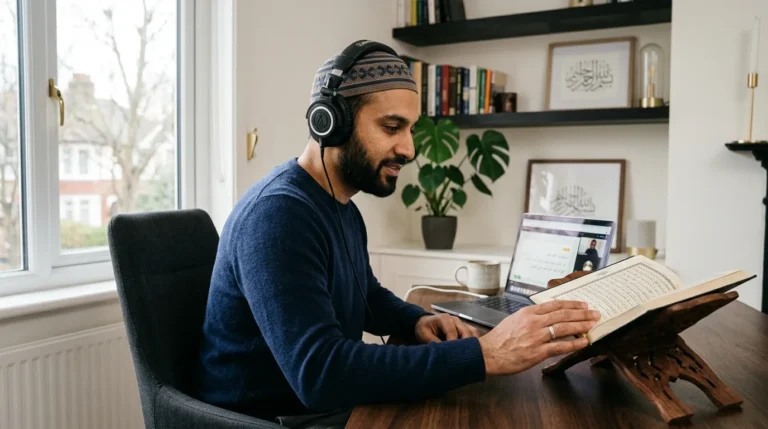
A technique called shadowing — listening to a short phrase from a qualified reciter and immediately repeating it, matching not just the words but the exact sound and rhythm — is particularly effective for accent correction, because it trains the ear and mouth together rather than relying on written rules alone.
Choosing very short phrases, sometimes even single words, and shadowing them repeatedly before moving to the next phrase, produces better results than trying to shadow entire verses at once, since shorter segments allow more precise attention to each specific sound.
Being Patient With a Gradual Process
Accent correction, unlike memorizing a rule, is a gradual, physical retraining process rather than something that clicks instantly once understood intellectually. Expecting overnight results often leads to unnecessary discouragement, when in reality steady, incremental improvement over several weeks is the realistic and normal pace of progress.
Celebrating small, specific improvements — noticing that one particular letter now feels more natural, for example — helps maintain motivation through what can otherwise feel like a slow and sometimes frustrating process.
When to Get a Teacher Involved
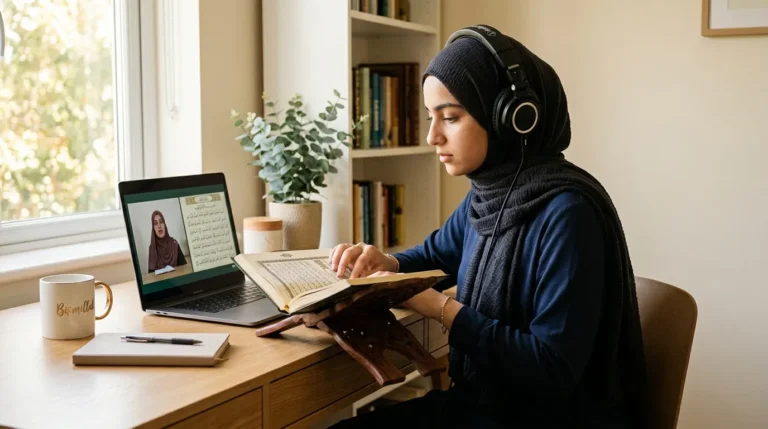
While self-practice through isolation and shadowing genuinely helps, certain accent-related habits are difficult to fully self-correct, particularly for sounds that don’t exist at all in your native language and therefore aren’t something you can accurately judge by ear alone.
A teacher who can hear the specific substitution happening and demonstrate the correct mouth position directly, rather than through written description, often resolves in a single session what might otherwise take weeks of uncertain self-practice to identify and fix.
Why This Is Rarely Discussed Openly, and Why That's a Problem
Accent-related challenges in recitation are extremely common, yet they’re often treated as an embarrassing personal shortcoming rather than a normal, expected part of learning Arabic as a second or third language. This silence around the topic can make individual students feel isolated in a struggle that is, in reality, shared by the vast majority of non-native reciters worldwide.
Open, judgment-free discussion of accent correction — treating it as a mechanical, learnable skill rather than a source of embarrassment — tends to produce faster, less anxious progress than an environment where the topic feels uncomfortable to bring up directly with a teacher.
How Age Affects the Speed of Accent Correction
It’s worth acknowledging honestly that younger learners, particularly children, often acquire new sounds more quickly than adults, simply due to how language-learning ability changes across the lifespan. This doesn’t mean adult learners can’t achieve excellent, accurate pronunciation — many do — but it does mean that patience and realistic timelines are especially important for adult students working on accent-related corrections.
Adult learners who approach this process with the same patience they might apply to learning any complex physical skill, rather than expecting the same pace of progress a child might show, tend to stay motivated through the naturally slower, more gradual timeline involved.
The Value of Group Awareness Without Group Comparison
Knowing that certain accent-related habits are common among speakers of your specific native language can be genuinely useful, since it helps target practice toward the specific sounds most likely to need attention. However, this awareness is most helpful when it informs your own individual practice rather than becoming a basis for comparing your progress against other students from a similar background.
Every individual’s mouth, ear, and prior exposure to Arabic sounds differs somewhat even within the same language background, so treating shared tendencies as useful information rather than a fixed prediction keeps the focus appropriately on your own specific recitation.
Maintaining Progress Once a Sound Has Been Corrected
Once a specific accent-related habit has been successfully corrected in slow, deliberate practice, there’s still a risk of it quietly returning under stress, fatigue, or simply reciting faster than usual, since the older habitual pattern doesn’t fully disappear even after a new one has been established. Periodically checking previously corrected sounds, especially during faster or more casual recitation, protects against this kind of gradual regression.
This ongoing maintenance doesn’t need to be intensive — a brief, occasional check-in on previously difficult sounds, folded into regular practice, is usually enough to keep a corrected accent habit stable over the long term.
Balancing Accent Correction With Continued Overall Progress
It’s important not to let accent-focused correction consume so much practice time that overall progress through memorization or new material stalls entirely. A reasonable balance involves dedicating a specific, limited portion of each practice session to targeted accent work, while the remainder continues normal progress through new material or review.
This balanced approach prevents the frustration that can come from feeling like all forward progress has stopped in favor of narrow, repetitive correction work, while still ensuring that accent-related habits receive the consistent, deliberate attention they need to genuinely improve over time.
How Community and Group Settings Can Either Help or Hinder This Process
Reciting regularly alongside others who share similar accent-related habits, without any corrective feedback present, can sometimes reinforce existing patterns rather than helping to change them, simply because the surrounding sound environment matches and normalizes the very habits being worked on individually elsewhere.
Balancing group recitation, which offers valuable community and motivation, with dedicated individual practice sessions focused specifically on correction, tends to work better than relying on either setting exclusively, since each offers something the other doesn’t provide as effectively.
Recognizing Genuine Progress Even When an Accent Isn't Fully "Gone"
Because complete elimination of every trace of a native accent isn’t a realistic or even necessary goal, it’s worth developing a more nuanced way of recognizing genuine progress — specifically, whether the letters that actually change meaning or violate a clear Tajweed rule have improved, rather than expecting your recitation to sound indistinguishable from a native Arabic speaker’s in every possible respect.
Reviewing recordings specifically for this narrower, more meaningful kind of progress, rather than a vague overall sense of “sounding more Arabic,” provides a clearer and more encouraging picture of the real technical improvement that’s actually taking place over time.
A Note for Reciters Who Feel Discouraged by Comments From Others
Unfortunately, some reciters receive unhelpful or overly critical comments about their accent from well-meaning but untrained listeners, which can be discouraging even when the underlying pronunciation is technically accurate. Distinguishing between genuine, specific, Tajweed-based feedback from a qualified teacher and general, informal opinions about how an accent “sounds” helps filter out unhelpful criticism that isn’t based on actual Tajweed correctness.
Trusting structured, specific feedback over vague general comments protects both your motivation and your accurate understanding of what genuinely still needs work, rather than being pulled off course by casual observations that may not reflect real Tajweed standards at all.
How Traveling or Studying Abroad Can Accelerate This Process
Extended exposure to native Arabic speakers, whether through travel, study programs, or regular online interaction with Arabic-speaking teachers, tends to accelerate accent-related improvement considerably compared to structured practice alone, simply due to the sheer volume of natural, varied exposure involved. This isn’t accessible to every student, but even occasional exposure through this kind of interaction can meaningfully support the more structured practice methods described throughout this article.
For students without regular access to native Arabic speakers, seeking out a wide variety of recorded reciters, rather than relying on just one or two reference voices, provides some of this same beneficial variety of natural, correct pronunciation to learn from.
A Realistic, Encouraging Summary for Non-Native Reciters
It’s worth closing on an encouraging note: the overwhelming majority of the world’s Quran reciters are non-native Arabic speakers, and countless students from every conceivable language background have successfully developed clear, accurate, beautiful recitation despite starting with a completely different native accent. Your specific starting point, whatever it is, is a normal and common one, not an unusual obstacle unique to your situation.
Why Consistency in Daily Life Supports Recitation Accent Work
Occasionally practicing basic Arabic conversation or vocabulary outside of Quran recitation specifically, even briefly, can reinforce correct mouth positions in a broader context, since accent correction generalizes somewhat across any Arabic speech, not only Quranic recitation specifically.
Key Takeaways
- A regional accent in recitation is a natural result of your native language's sound patterns, not a personal failing, and it's a fixable, specific set of habits rather than a vague general problem.
- Distinguishing between a harmless accent quality and an actual letter substitution helps prioritize what genuinely needs correction.
- Slow, isolated practice and shadowing short phrases from qualified reciters retrain the mouth and ear more effectively than reading full passages at normal speed.
Frequently Asked Questions
Is it necessary to completely lose my natural accent to recite correctly?
No, the goal is correct pronunciation of Arabic letters and rules, not the complete elimination of every trace of your native accent, which isn't necessary or realistic. Focus specifically on sounds that change the letter itself, rather than general tone.
Why do I still slip into old habits when reading quickly?
New pronunciation habits typically need to be solid at a slow pace before they hold up at faster reading speeds, so slipping back at higher speed usually means more slow, isolated practice is still needed before speeding up.
Can shadowing alone fix pronunciation without a teacher?
Shadowing helps significantly, but a teacher provides a level of real-time, specific correction — particularly for sounds you may not be able to judge accurately by ear yet — that shadowing alone typically cannot fully replace.
Get Feedback on Your Specific Accent
A teacher can identify exactly which sounds carry accent-related habits and guide you through correcting them.
Book a Free Trial Class Chat on WhatsApp