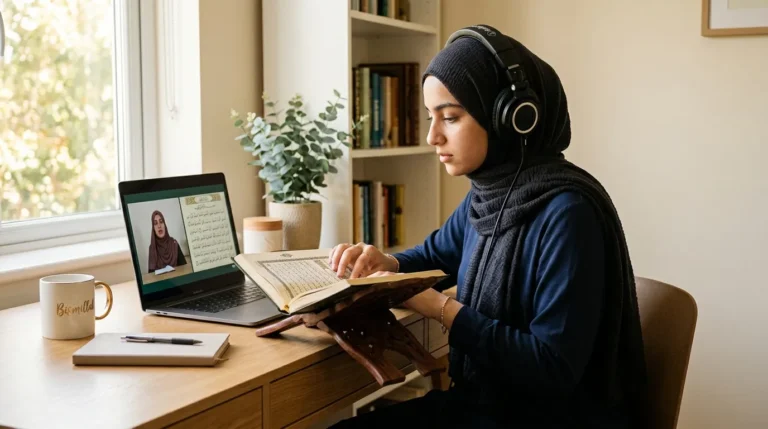
Juz Amma for Beginners: Where to Start Memorising and in What Order
Juz Amma is the 30th and final part of the Quran, from Surah An-Naba (78) to Surah An-Nas (114), which is 37 surahs. Many learners begin memorising here because its surahs are short and often heard, and a common approach is to learn Al-Fatiha first and then start with the shortest surahs, such as An-Nas, Al-Falaq and Al-Ikhlas.
Ask a teacher where a new memoriser should begin and most will point to Juz Amma. This guide explains what it is, why it works as a starting point, and offers a sensible order of surahs with verse counts so a beginner can plan. It does not claim there is only one correct order.
What is Juz Amma?
The Quran is divided into 30 equal parts called juz. Juz Amma, named after the first word of Surah An-Naba, is the 30th part. It runs from Surah An-Naba (78) to Surah An-Nas (114), and contains 37 surahs. In the Madinah mushaf it begins on page 582 and ends on page 604, so it is about 23 pages long.
Why many learners begin here
- Short surahs. Many have only three to nine verses, which gives a beginner early, achievable wins.
- Familiar sounds. Several of these surahs are widely recited, so the rhythm is often already in the ear.
- Strong foundations. They give practice in the basic rules of Tajweed on manageable text.
Forward or backward?
Two approaches are common. Some teachers start from An-Nas and move backwards towards An-Naba, because the surahs get gradually longer as you go. Others start from An-Naba and move forward, following the order of the mushaf. Both are used successfully. What matters is steady revision and a pace you can sustain.
A suggested starting set
This is a suggestion for beginners, not a rule. Al-Fatiha comes first because it is so central in daily prayer.
| Order | Surah | Number | Verses |
|---|---|---|---|
| 1 | Al-Fatiha | 1 | 7 |
| 2 | An-Nas | 114 | 6 |
| 3 | Al-Falaq | 113 | 5 |
| 4 | Al-Ikhlas | 112 | 4 |
| 5 | Al-Masad | 111 | 5 |
| 6 | An-Nasr | 110 | 3 |
| 7 | Al-Kafirun | 109 | 6 |
| 8 | Al-Kawthar | 108 | 3 |
| 9 | Al-Ma’un | 107 | 7 |
| 10 | Quraysh | 106 | 4 |
| 11 | Al-Fil | 105 | 5 |
| 12 | Al-Humazah | 104 | 9 |
| 13 | Al-Asr | 103 | 3 |
Verse counts follow the standard Hafs numbering used in the Madinah mushaf. Your teacher may prefer a different order, for example to match what a school or mosque programme is teaching.
Revision matters more than speed
Add a new surah only when the previous ones are secure. A simple habit is to recite everything you have already learned once a day, and to ask your teacher to test you weekly. If you find that earlier surahs slip as new ones arrive, our guide to stopping the forgetting covers the revision habits that help, and the weekly pace guide explains how much to add.
Learn the meaning alongside
Short surahs are a good place to learn what the words mean as well as how they sound. Even a one-line explanation from your teacher helps the verses stay in memory and makes recitation more thoughtful.
Notes and sources
Page numbers are for the 604-page Madinah mushaf and differ in other editions. Starting orders vary between teachers and traditions.
- Juz table with Madinah mushaf page numbers
- Study noting both starting directions in Juz Amma (UIN Sunan Gunung Djati)
Key Takeaways
- Juz Amma has 37 surahs, from An-Naba to An-Nas
- Start with Al-Fatiha and the shortest surahs
- Revise before adding anything new
Frequently Asked Questions
Do I have to memorise Juz Amma first?
No. It is a common and practical starting point, not a requirement. Some students begin with surahs they hear in their community or that their teacher selects.
How long does Juz Amma take?
It varies widely with age, time available and revision habits, so a single figure would be misleading. Ask your teacher to set a pace after assessing your level.
Is Al-Fatiha part of Juz Amma?
No. Al-Fatiha is the first surah of the Quran, but it is usually learned first because of its place in daily prayer.
Plan your first surahs with a teacher
A free trial class helps set a realistic order and pace for you or your child.
Book a Free Trial Class Chat on WhatsApp