What Age Should a Child Start Learning the Quran? A Practical Guide for Parents
There is no single fixed age. Exposure to recitation can begin very early, while formal lessons are best started when a child is ready, which for many families means the early primary years, and a child who starts later can learn just as well. Readiness matters more than the number.
Many parents worry that they are starting too late or too early. Scholars and teachers generally agree that there is no single required age, and that the better question is whether the child is ready and whether learning will be gentle. This guide offers practical signs of readiness, ideas for the years before formal lessons, and common mistakes to avoid.
What scholars and teachers say
Guidance from Islamic scholars is practical rather than numerical. One widely cited answer advises that if a child shows ability and a strong memory, it is wise to begin early, while another notes that if early teaching is affecting a child, parents should wait until the child is a little older. Others stress that teaching should match each child’s abilities, which differ from child to child. The consistent theme is early love, gentle teaching and attention to the individual child.
Before formal lessons: ages and stages
You do not need a teacher to begin building a connection to the Quran. Common, low-pressure steps include:
- Playing clear recitation at home, so the sounds become familiar.
- Learning very short surahs by listening and repeating together.
- Teaching respect for the mushaf and simple manners around it.
- Playing letter-recognition games with Arabic letters.
Signs a child may be ready for formal lessons
- Can sit and pay attention for a short stretch, with a parent nearby.
- Enjoys listening to and repeating sounds.
- Begins to recognise letter shapes or is curious about them.
- Follows simple instructions from an adult who is not a parent.
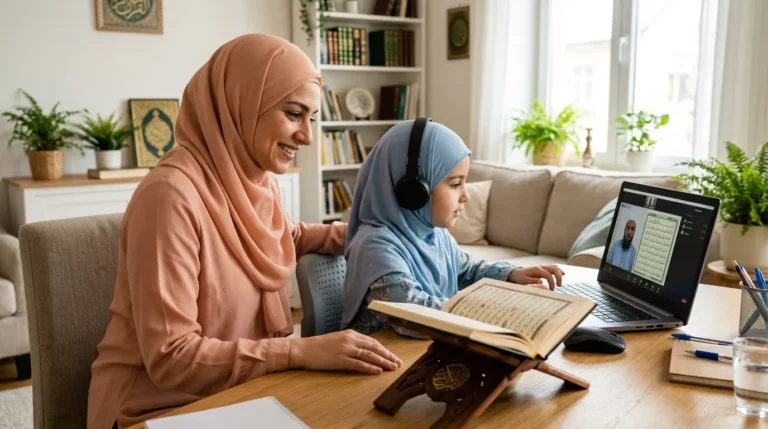
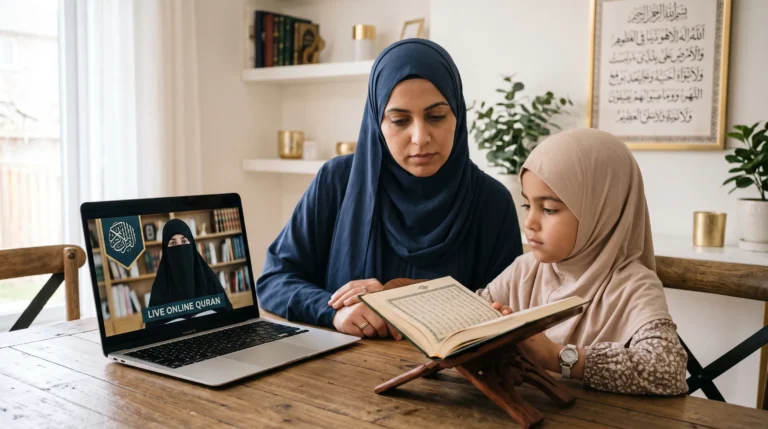
- Can manage a short, structured lesson, including an online one with a screen.
Parent guides often quote a range of roughly four to seven years for starting letters and basic reading. That is a convention drawn from experience, not a rule, and a child who is outside it is not behind or ahead in any meaningful sense.
Starting Hifz is a separate question
Learning letters and reading is one stage, and memorisation is another. Many families begin with short surahs by listening, then add structured memorisation when reading is secure. Some children are ready earlier and others later. A teacher can assess this after hearing the child recite. Our memorisation classes page describes how new work and revision are balanced.
If your child is older or starting late
An older child, or a teenager, can learn well, often faster, because they follow instructions and understand why a rule matters. The main challenge is confidence: an older beginner may feel embarrassed to start with letters beside younger children. One-to-one lessons remove that comparison. If this sounds like your child, see our guide to feeling embarrassed about mistakes.
Mistakes to avoid
- Pressure and comparison. Comparing a child with siblings or classmates tends to reduce interest.
- Long sessions. Short, regular lessons usually work better than long ones for young children.
- Harsh correction. Gentle correction builds confidence, and fear can make a child avoid recitation.
- Skipping basics. Rules taught too early or letters rushed lead to habits that are harder to fix later.
Notes and sources
This guide offers general educational advice and is not a ruling or child-development assessment. If you have concerns about attention or learning, speak to your child’s school or a qualified professional.
- Daruliftaa: The proper age for a child to start Quran
- IslamOnline: When should I teach my child the Quran?
Key Takeaways
- There is no single required age; readiness matters more
- Build familiarity early with listening and short surahs
- Older beginners can learn well, especially in one-to-one lessons
Frequently Asked Questions
Is it too late to start at ten or twelve?
No. Older children can learn well. Start with the basics, keep lessons positive and let the child progress at their own pace.
Can a three-year-old learn the Quran?
A three-year-old can listen to recitation and repeat short phrases, which builds familiarity. Formal lessons with letters are usually better when the child can sit and attend for a short time.
How long should lessons be for young children?
Short and regular. Your teacher can suggest a length after seeing how your child focuses, and can adjust as attention grows.
See if your child is ready
A free trial class lets a teacher meet your child and suggest whether to begin with listening games, letters or reading.
Book a Free Trial Class Chat on WhatsApp